Editorial
For the past month, I've most definitely been "living in interesting times" as the Chinese saying goes. You can read some of it in the Future Proofing item—though you may have to go between the lines for the details  . Still and despite all that, this month's issue lives up to the name with lots of News about Model Engines.
This issue is a big one (guilt over the brevity of the July issue actually). It's the coldest time of the year here in the Wide Brown Land, so shop activity has been near zero—which is what the temperature in the shop feels like. However I did manage to hone a couple of the Morton M5 cylinders (the original versions with the cast-in liner). Wow! did that take some doing. One cleaned up to fully honed at 0.621", while the other is now at 0.625" and still has a section of liner near the top that has not been touched! I wanted to get then all to the same size so I could make "standard" rings, but that looks like a pipe dream now. This should not be the case for the Satra cylinders with the separate liners though. Anyway, original Morton Builders have my sympathy and admiration.
And speaking of Mortons, everyone should have their issue #2 of Model Engine Builder by now (all of you are subscribers, aren't you? ) The work put into the M5 drawings and 3D models by Robert Seigler was absolutely top, and our own Ken Croft's very pragmatic approach to cylinder and piston honing (or lapping if you prefer) should ensure success for all to whom this is a bit of a mystery—just do exactly as Ken says and all will be well. If you visit the MEB website, you might notice a change in the mast-head that will flow through to the next issue of the magazine—yes, there is a story behind that—but all's well that ends well, especially for Mike when he lands a new and prestigious advertiser. And speaking of the next issue, I happen to know that it will contain an article on building the poppet valve "Morton" M1 (and yes, there is another valve variation under test). Aspiring M5 builders might like to start with this one to develop their tooling before moving onto all the repetition work.
First item: The Grand Anouncement! Almost...
The MEN-ONLY CD Collection

Hard as this may be to believe, the Model Engine News CD is in beta test with trusted victims and is about ready to ship. The single, usable as-is CD will contain almost everything on this web-site. I've dropped some unreachable and unusually irrelevant stuff in order to make room for a bonus "cookie"; material that will never appear on this web site. Click on the photo to go to the page detailing what you can expect from the CD, and how to order it.
A little Future Proofing
There was some sad news broken in a Computerworld article last month. Specifically, DSTC has not as long to live as I'd hoped. So in an attempt to future-proof on-line access to this web site, I've set up a redirecting link that will be take you to *wherever* Model Engine News happens to be hosted. I've also registered modelenginenews.com which eventually will be the domain for access to the web site, and for email enquiries, but that's not ready yet. The URL for the redirect is:
http://home.exetel.com.au/men
Note that this has not been hyperlinked as it is a "redirect" that today, immediately takes you to the current location on DSTC's servers. Where it will take you tomorrow might be someplace different. Anyway, I'm hoping that the final address (www.modelenginenews.com) will be active by the end of August. Stay tuned...
New Watzit

We haven't had a new Watzit for a while. Roger Schroeder spotted this one on eBay. We may not know what it is, but we know a little about where it's been. Checkout the Watzit entry to discover watz known and watz surmised. If you can shed extra light, we'd sure be pleased to hear about it.
Sleeve Valve Flat Six

Tom Pascoe has been at it again. Remember his Beare Six-Stroke and his Sleeve Valve Radial? Well, taking a basic design for a sleeve valve cylinder proven first in a single cylinder engine, and later adapted and enlarged for the radial, Tom has created a new Sleeve Valve Flat Six that is not what it at first appears. The engine is still under development, and until Tom is happy, will not get the "exhibition finish" treatment. In the mean time, it has been photographed in action by Ken Croft who reports that it sounds delightful. Click on the thumb-nail, or the link for the sneak preview.
The Truth Is Out There

Sorry, couldn't resist it . Actually, it's the plan that's out there...the X-List plan that is. Let me explain. Over the years from 1936, the family tree of magazines created (initially) by the Model Aeronautical Press (MAP) has published a truly vast number of plans for model airplanes, boats, cars, "space-age" models, model engineering tools, devices, and even IC engines.

The older MAP Plans Books are a treasure and a sought-after collectable. As time went on, the less popular plans went onto what was called the "X-List". Plans in this list were no longer illustrated in the plan books, but could still be obtained on special order. Times change, mountains of masters grow, and the X-list, along with the Aeromodeller and the plans faded away.
The good news is that a group of dedicated modelers has managed conclude a deal to make these old plans available again. So click on the X-List icon above if you are after a readable copy of the Sugden Special plan, or the extensive and expensive plan set for LC Mason's Mastiff, a water-cooled, four cylinder, side-valve, boxer, plus lots of others. The X List Plans site has new been added to the Commercial Links section.
Gipsy Major
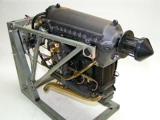
It's difficult to tell, but you are looking at a scale model the de Havilland Gipsy Major, built from plans and casting available from Reinhold Krieger (Germany). The pictures and info came via Eric Offen who is having a hard time withstanding the temptation to build one. So could you—if you have 800 Euro to spare. Or, if you prefer, you can buy an actual completed Gipsy from Reinhold (be quick, supplies are limited). More details and pictures are on Page 6 of the Gallary. I've re-translated the description translation (I'm relatively sure that a "chook-flap" is actually a "choke", unless you live in rural Australia, or certain parts of outer Sydney ).
Four-Strokes on CD

After writing the piece on the Gipsy, I received a nice email and some more pictures from Reinhold. It appears that in addition to being a most prolific (and expert) engine builder, he has also found the time to catalogue over 350 four-stroke model engines and place them on a CD. The engines are mostly home constructed, although there are some commercial models included. Click the picture of the Chenery side-valve above to see examples from the CD. You can email Reinhold for further information, or place an order at re.krieger@t-online.de.
Sneaky
Within a week of posting last month's page, pangs of guilt over its brevity, and a slight relief in pressure here urged me to do a sneaky incremental "bis" release. Now I know from the hit counter that a lot of my loyal readers hit the URL on the first day of the month. If you did this, I suggest you go back to the page (probably best to hit your Browser Refresh button in case the page has been cached). The late additions were The Allan Roberts Collection, some corrections, and a contact snail-mail address from Gordon Cornell, author of the excellent Model Engine Mechanics reference. There's also extra words in the Editorial describing a late fix to the operation of the Menu in the left-hand navigation bar.
eX-Olie

Cross-sectionalized machinery of all kinds has always fascinated me, even though it's a rather terminal process. However, Ken Croft (who sent the picture) assures me that no live Oliver Tigers were killed or injured in the production of this photograph; the engine in question being well and truly dead at the time, making this a fitting end for it. The work was done by John Goodall, one-time editor/publisher of Model Engine World magazine. And even I have to admit he's done quite a nice job of it. I don't know what crash damage he had to work around, but the case cut-away nicely reveals all the salient design features of this classic engine.
Actually, the arrival of this photo is remarkably timely as the cylinder porting design of the Oliver Tiger was the inspiration for that used by Dave Sugden on his Sugden Special, the Engine of the Month in this issue. Pay special attention to the transfer port visible on the far side of the cylinder liner, the way the crankshaft is counter-balanced, and the low crankcase volume. Then read the Sugden article. The profiling job on the inside edges of the backplate is also worthy of note. This was just one of the little mods made by owners seeking the last possible bit of performance from this fine engine.
Incidentally, Gordon Cornell's book mentioned last month has a very enlightening table in the appendices. This table gives Break Horse Power (BHP) and Break Specific Consumption (BSC) figures at maximum efficiency and maximum power RPM for 29 engines tested by Aeromodeller up to June, 1959. All these tests used their eddy-current dynamometer, so even if the actual figures are wrong, they are all equally relative. They show that at the time, the Oliver Tiger at 0.31 BHP was only marginally better than the nearest rival in the 2.5cc class; namely the Enya 15D at 0.29 BHP. But, and this is a VERY BIG BUT, at this maximum power setting, the Tiger's BSC was 0.36 compared to the Enya's whopping 0.67 (cc's of fuel consumed per BHP, per second). This equates to a gigantic range advantage in the team race event where the Olie reigned supreme.
AMEE

A long term project by the editor of the Engine Collectors' Journal, Tim Dannels, has finally come to fruition. Many years ago, the ECJ published an index of American model engines as a multi-part series. Tim has expanded this already mammoth undertaking to produce the definitive American Model Engine Encyclopedia. I've not seen the result yet, but wasted no time placing an order. Click the photo for more detail of the content, and how to place your order. I was hoping to have a full review in this issue, but the postal services have conspired against us (the use of priority may have been a mistake). But be assured, a review will appear here when my copy arrives.
ED Bee Update

Just to prove that no story is ever fully told, one obscure sentence of an article in the #8 SAM35 Year Book caught my eye last month. The article, by Ron Moulton, chronicles the history of the pioneering English engine and R/C equipment manufacturer, Electronic Developments (ED) Ltd. That sent me off to The Library where the new information caused alarm bells to ring regarding the accuracy of some previous information. You can read the result in the update to ED Bee review. Click the link to go straight to the update, or the picture for the full review.
New Books and Magazines This Month

This month's new book is Building the Maltese Falcon, by Jim Shelley, published in England by Camden Live Steam, ISBN 0-9536523-8-6, 2003. It is A4 size (8-1/4 x 11-3/4), spiral bound with 32 pages of glossy photographs and text, followed by 11 A3 size fold-out pages of drawings (11-3/4 x 16-1/2"). My copy, and presumably all other first edition copies, came with a replacement for one of the drawing sheets, printed on the reverse side with a publishers apology, and a list of errata. Would have been nice if the replacement had been punched for insertion, but you can get there with scissors and glue.
The engine detailed in the book is an air-cooled, four cylinder, side-valve four-stroke. As you can see from the cover picture, having no over-head valve gear to accommodate makes for a very compact "boxer" configuration. It is fitted with a pull-starter, and has a magneto turning at twice crankshaft speed for the ignition. Lubrication is pressure fed from the 400cc sump. This is a big engine (seems like this is the month for "big"). The bore and stroke are both 44mm, giving a total displacement of 240cc. The design came about from the author's desire for a power-plant that would fly his 15 foot span scale Taylorcraft with a scale-like prop and sound. Development consumed six years and from the evidence of the photographs, he has been successful.

No complex castings are required to complete the engine. In fact it could be built entirely from bar-stock and plate; the builder having to buy only the bearings, fasteners, and the Minimag magneto. The supplier of the latter may also be able to supply a casting for the crankshaft—which would save *lots* of chips—and you have the option of using Honda pistons, rings and valves (Honda motor cycle parts; this thing is bigger than a lot of bikes on the road today). The drawings show the piston details for those who prefer to make their own, but omit the details of the two compression and single oil scraper rings.
The book is not a step by step "how-to", and does not claim to be. Anyone tackling an engine of this size (a very lethal size, I might add), can reasonably be expected to require little to no assistance. The text works through the major engine components and subassemblies, covering only the less obvious aspects of the design and assembly. The black and white photographs that accompany this section are clear and will answer most questions with a minimum of head scratching, although they represent a number of stages in the evolution of the design.
The plans are "reasonable". They are hand drafted and lettered (not CAD), and the title box indicates that they were checked by the designer. My reading showed some errors—as well as the lack of ring data already mentioned. The lateral cross section shows the "old" combustion chamber shape. This is substantially different from the shape seen in the 3D model cross section on the rear cover. The head drawing itself does not supply the full height dimension for the head; only the fin depth. A note in the page discussing the head evolution suggests 1.25", but omissions of this type clearly indicate that this is an engine for the experienced constructor.
I find it hard to come up with an opinion either for, or against someone else buying this book. On the one hand, I can never really see myself building one. On the other, the way Shelley went about implementing his side-valve cylinders would scale down, and has given me an idea that may enable me to build a Westbury Kinglet without the aid of castings, so it may have been worth the modest cost for that alone. But if you are one of the Giant R/C Scale Brigade, the engine may be just the ticket. I've looked and looked, but can find no explanation for the name—if there's a Bogy connection in there, it's way too subtle for me!
Engine Of The Month: Sugden Special

The Sugden Special high-performance diesel (these things are relative) will probably need no introduction to English, Kiwi, and Ozzie readers, but may be new to those in the USA. The serialized series describing its construction began in the Aeromodeller, issue 227 of December 1954 (with the lovely C Rupert Moore "Mossie" painting on the cover, and plans for a C/L scale Mosquito powered by two ED Racers inside).
Although it is now over 50 years old, the Sugden Special would still make a fine project choice for any model engineer with a little IC experience under the belt. In fact, it was a Google search on the Sudgen that led to the X-List Plans mentioned above (plan U588). The engine has been on my must-build-someday list since just about forever. I'm no closer, but that's no reason you shouldn't be. Click the picture above to read all about the Sugden, and I do mean ALL.
And be warned if you want to repeat the web search: a popular BBC TV comedy series called Are you Being Served? had one Molly Sugden as a cast member (no relation as far as I know). She also did some TV "specials", so expect lots of false hits unless you add extra filtering terms to the search .
Tech Tip of the Month: Crankshafts Again

Remarkable how some things that should be memorable somehow manage not to be. While preparing the Sugden Special review for this issue, the way that Dave Sugden had tackled the machining of the crankpin absolutely leapt off the page at me. Now I must have read this a number of times previously, but somehow this very unusual technique never managed to have much of an impact. But it looked perfectly practical, especially for small shafts, so the How To Make Crankshafts page has got an update based on my tests of Dave Sugden's pin forming method.

 The MEN-ONLY CD Collection
 Editorial


