Allen Mercury "AM" Range
 |
| Name | AM35 | Designer | Dennis Allen |
| Type | Compression Ignition | Capacity | 3.5cc |
| Production run | Lots! | Country of Origin | England |
| Photo by | Ron C | Year of manufacture | Late 1950's |
Background
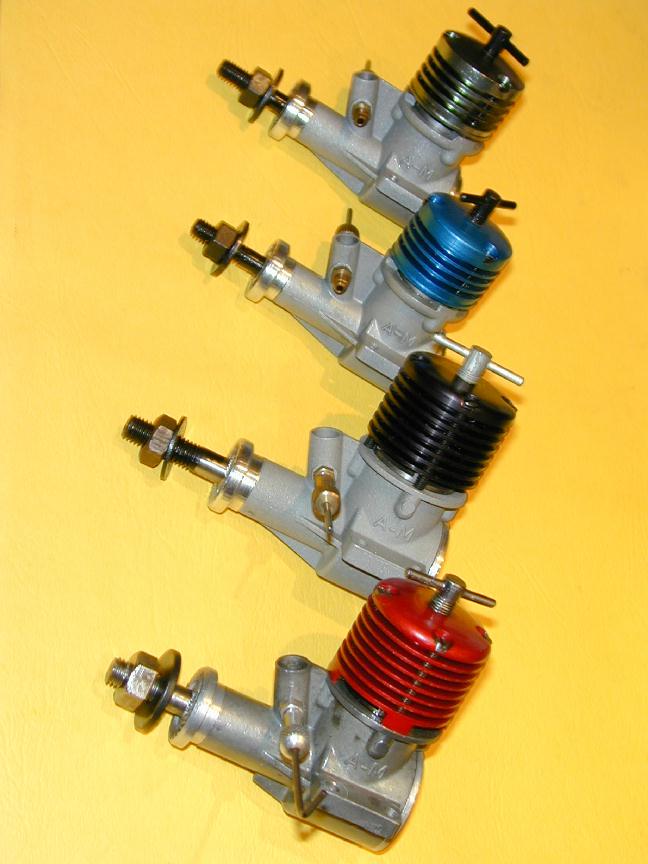
The AM35 is the largest in the range of four engines designed by Dennis Allen for Mercury Models in England during the 1950's ("AM" being Allen-Mercury). The range comprised the AM10, AM15, AM25 and AM35 where the numeric component of the designation represented the capacity in cc's, multiplied by ten. Thus the "10" (green head) is a 1cc engine, the "15" (blue head) a 1.5cc, etc. The designs can properly be considered as two pairings of engines with a common crankcase and crankshaft, having interchangeable cylinder/piston assemblies to provide the 1/1.5 and 2.5/3.5 capacity models.
Dennis Allen is a man with an interesting career, as reported by Ron Warring in his review of the AM25 in Aeromodeller of October, 1954 (reviews of the AM10 and 35 appeared in the Aug '56 and Nov '55 issues respectively). A well known and respected modeler in control line and radio control, Den Allen initially ran the engine repair facility for HJ Nicholls of Mercury Models. Following the closure of this service, Dennis was "loaned" to Allbon to sort out design problems there, eventually becoming a full time employee. When Allbon were taken over by Davies-Charlton, Dennis moved to Anchor Motors and contributed to the AMCO 3.5cc design.
Next, he approached HJ with a proposal for a new series of high performance engines and the result became the Allen-Mercury range, manufactured by Allen Engineering, and distributed by Mercury Models. My information on his activities during the 60's through the 80's is scant. A 1993 Aeromodeller article titled Dennis Allen, Motor Mystro indicates that he had some involvement with Merco production before bowing out of the hassles of overseeing an engineering works to quietly manufacture glow plugs. The article also mentions an involvement with the design and manufacture of a four-stroke called the Condor—a short-lived engine appearing in 0.91 and 1.2 cuin version.
In the 90's, Dennis seems to have returned to his roots, designing and producing another range of sports diesels. These are known as the "AE" range with capacities of 0.13cc, 0.5cc, 1cc, 1.5cc and 2.5cc—all manufactured from bar stock with a common appearance and black anodized crankcases—which is another story.

The AM25, introduced before the 35, went through some detail design changes involving a complicated stud arrangement for cylinder hold-down before settling down to that shown in these photos. To further complicate things for collectors, the AM range was re-introduced significantly after original manufacture had been completed by a company called Forest Engineering. The 10, 15 and 25 in the photo above are of this type, while the 35 is a restored original. Indicators are the shiny as-cast case and aluminum needle/spray bar for the originals, vs the light, blasted case finish and brass NVA's on the re-issue. The original 10 and 15 also sported an aluminum tank color coordinated with the head, while the newer ones had either no tank, or a white nylon one.
 The 35 appeared with both a brilliant red anodized head and a shiny pink one (I suspect a large batch of heads went through an anodizing bath that was less acidic than optimal for color take-up). Internally, they are noteworthy for having a sleeve fitted over the piston that makes the wrist pin totally captive in the inner piston. This provided the extra bore, but I've no idea how it was fitted and feel no curious compulsion to attempt pulling mine apart just to find out.

All engines follow a similar design. The cylinders are peripherally ported with exhaust and transfer ports slit either side of a flange that locates the cylinder in an oversize bore in the die-cast aluminum crankcase, thus providing the transfer passage. The cast iron piston has a conical top to assist scavenging; the contra-piston, also cast iron, has a matching concavity. The cylinder is retained by an anodized cooling muff that bolts to the case with 3 x 7BA screws in the case of the 10/15, and 4 x 6BA for the 25/35. The crankshaft is a conventional front-rotary design, knurled for a "splined" fit of the aluminum prop drive washer. The rear cover screws in, with the 10/15 unit carrying a tapped central spigot for a tank securing screw. The needle valve is conventional with a slit thimble for friction adjustment.

All engines are of light weight for their capacity and strong runners for plain bearing engines. When tested by Ron Warring in Aeromodeller Aug '56 (Engine Analysis #24), the AM10 was reported as developing a maximum of 0.113 BHP at 14,200 rpm, resulting in a power to weight ratio of 0.038 BHP per ounce. Other AM tests yield 0.045 BHP/ounce for the AM25 and 0.058 BHP/ounce for the AM35. By way of comparison, their test of the twin ball race, rear rotary induction, "Mk II" ED Racer (2.5cc) of Nov '54 rates it at only 0.0365 BHP/ounce, while the Mk I Oliver Tiger, reviewed in Dec '52, produced a very respectable 0.050 BHP/ounce.
The table below, drawn from data in Ron Moulton's Model Aero Engine Encyclopedia (1959 revised edition) summarizes the figures of the range.
| Model | Bore | Stroke | Displacement | Weight | Head Color |
| AM10 | 0.426" | 0.430" | 1.0cc (0.061 cuin) | 3 oz. | Green |
| AM15 | 0.517" | 0.430" | 1.48cc (0,089 cuin) | 3 oz. | Blue |
| AM25 | 0.570" | 0.562" | 2.4cc (0.147 cuin) | 4 oz. | Black |
| AM35 | 0.687" | 0.562" | 3.42cc (0.209 cuin) | 4.5 oz. | Red or Pink |

